PortIQ: narrative-to-math scenarios in 7 minutes
Walk through the PortIQ scenario engine — describe a stress in plain English, see factor shocks, P&L impact, and ranked hedging proposals in seven minutes.

PortIQ is our flagship portfolio analytics platform. It is also the product where our "narrative-to-math" thesis is most visible: a portfolio manager describes a scenario in a sentence, and PortIQ translates it into quantified factor shocks across the entire book — with P&L impact, marginal contribution, and a hedging proposal — in roughly seven minutes from the first prompt to a board-ready summary.
This post is the walkthrough. We have stripped out the marketing varnish and kept the substance: what you type, what PortIQ does, what the screens look like, and what we would ask the platform to prove in an evaluation.
The job PortIQ does
A portfolio manager's day is full of "what if" questions. What if rates move 75bps in the wrong direction over a quarter? What if the AI-capex trade unwinds the way the dot-com infrastructure trade did? What if EM sovereigns widen on a US dollar shock?
Most platforms can answer one of these — usually slowly, usually after a quant has wired up the scenario by hand. PortIQ is built around the assumption that a PM needs to ask twenty of them in an afternoon, get usable answers, and have an audit trail at the end.
The job is therefore not "run a stress test." The job is collapse the cycle time between a question and a defensible answer.
The architecture, in one diagram
PortIQ sits on top of six layers:
- Predictive Agents & Ranking — AI models for price, fundamental, and macro forecasting.
- Knowledge & Features — an entity-resolved, temporally aligned feature store.
- Risk Brain — LLM agents for sentiment, scenario generation, and narrative mining.
- Quant Core — factor models, stress engines, optimisation under constraints.
- Serving Layer — APIs, PM dashboards, IC reporting.
- Platform Cross-Cuts — security, observability, model governance.
The narrative-to-math engine is the integration of layers 3 and 4: the Risk Brain interprets the language, the Quant Core does the math, and the Serving Layer presents the result with the evidence chain visible.
The architectural choice that matters: the Risk Brain does not invent factor exposures. It maps language onto factors that already exist in the Quant Core's calibrated factor model. The LLM is a translator, not the source of truth.
The walkthrough — seven minutes, three steps
Step 1 — Type the scenario (minute 0–1)
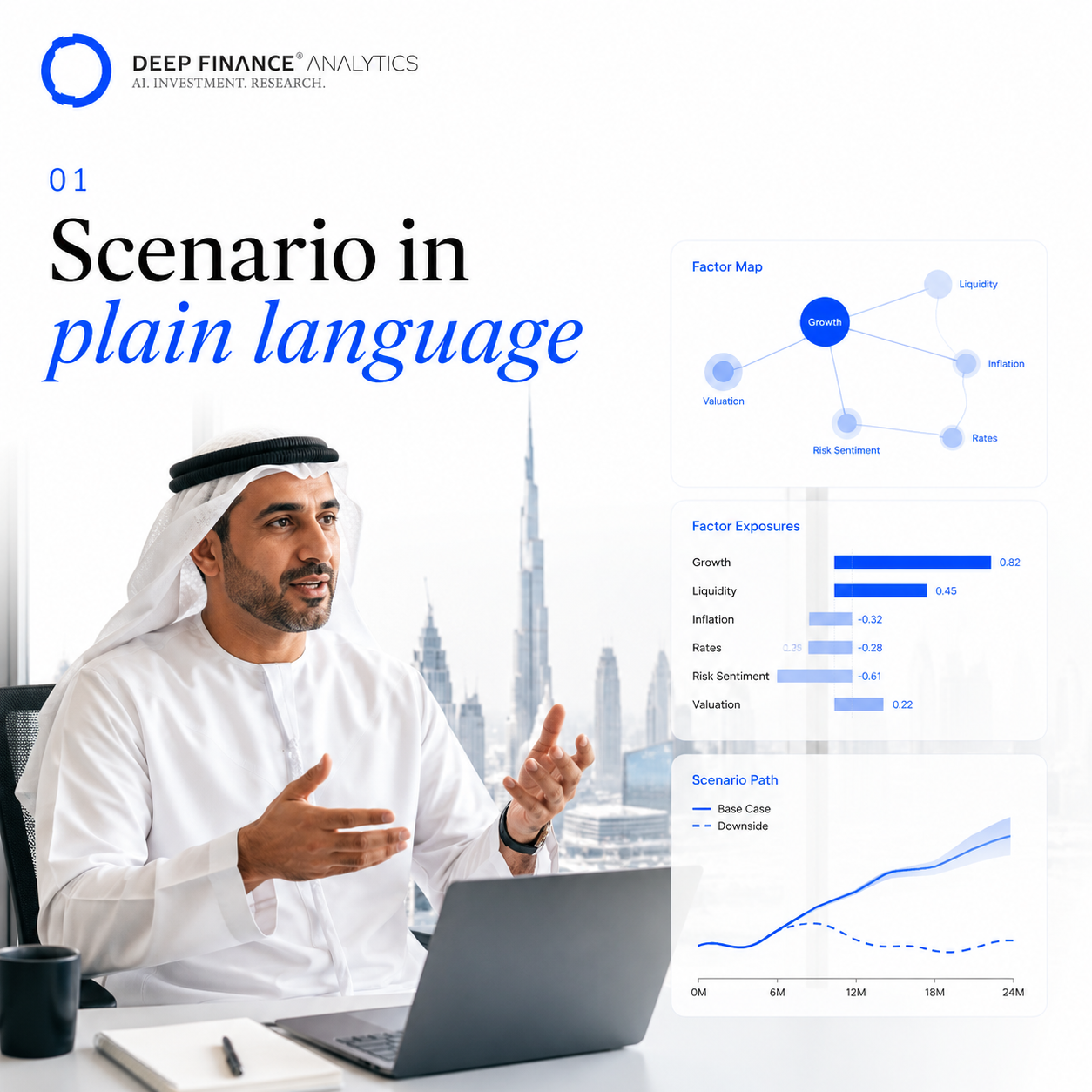
In PortIQ's scenario tab, you type or paste a plain-language scenario. Example:
"Tech selloff with credit widening and EM contagion — sustained over one quarter, similar in shape to Q4 2018 but with broader EM impact."
PortIQ shows you immediately how it interpreted the scenario: which factors it intends to shock, the magnitude of each shock, and the analogue periods it considered when calibrating. You can edit any of those parameters before running. Critically, you can also see why — every interpreted factor has a citation back to the language that triggered it.
Step 2 — Run the engine and read the output (minute 1–5)
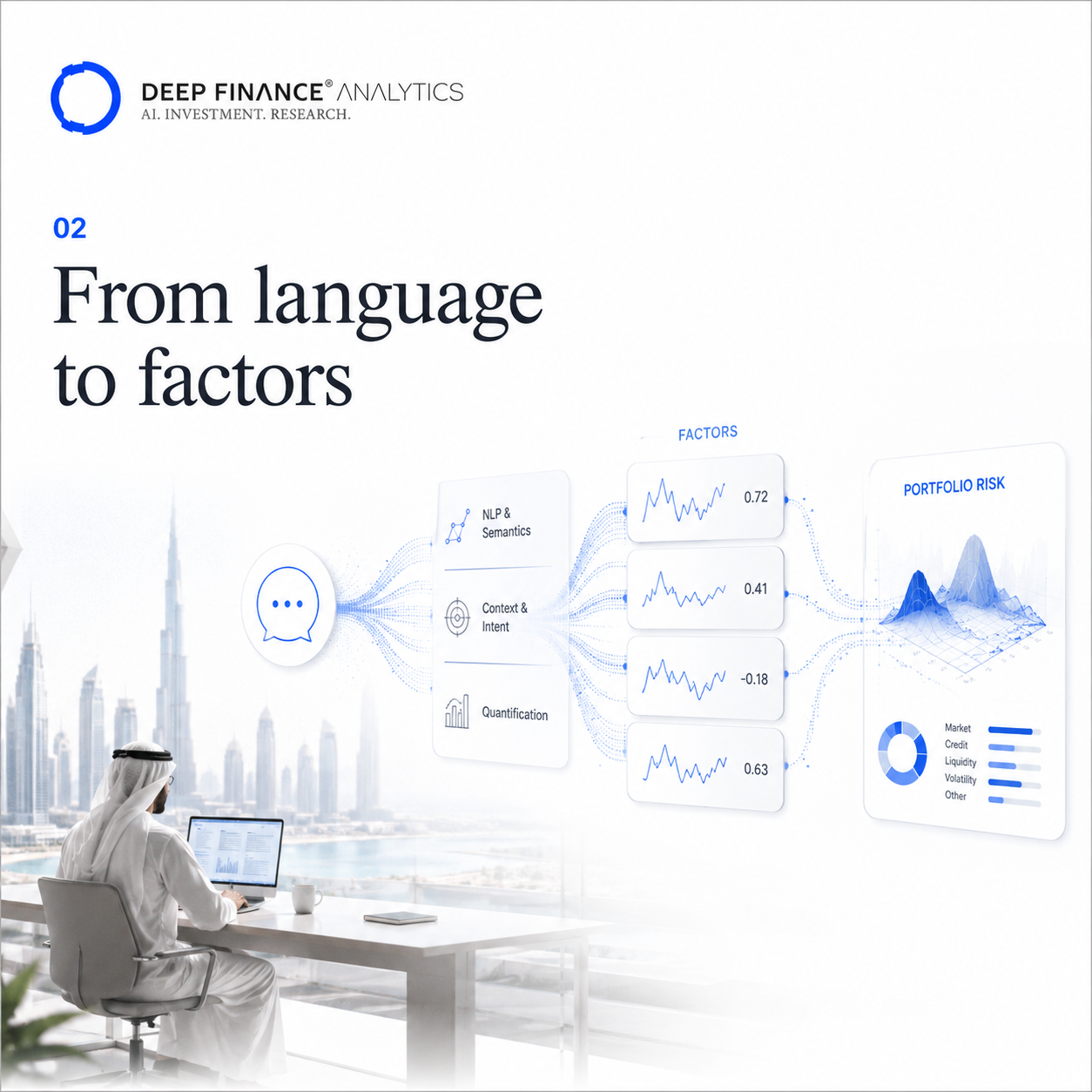
PortIQ runs the scenario across your full investment universe. Within a few minutes you have:
- Factor shocks applied across the book (e.g. equity factor −42%, duration −18%, credit spread +280bps, EM sovereign −31%).
- Portfolio P&L impact, decomposed by asset class and by factor contribution.
- Marginal risk contribution by position, so you can see which holdings drive the loss.
- Liquidity profile under the scenario, drawing on our Liquidity Intelligence agent.
- Hedging proposals — three candidate hedges ranked by P&L offset, cost, and tracking-error impact.
Every number on the screen carries an evidence chain. Click any factor shock and you see the calibration data, the historical analogues weighted into the calibration, and the model version that produced the shock. Click any hedging proposal and you see the constraint set the optimiser respected.
Step 3 — Iterate and export (minute 5–7)

The PM iterates. Take EM contagion out and replace with an oil shock. PortIQ recomputes. Hold the equity factor shock constant but stress duration further. PortIQ recomputes.
When the PM is satisfied, they hit export. PortIQ produces a board-ready summary — a short narrative explanation, the headline numbers, the hedging recommendation, and the evidence chain — as PDF, Word, or slides. Every export is logged.
That is the seven minutes.
What is different about this workflow
Three things, in our experience with clients:
- The scenario is the artifact. In legacy systems the artifact is the spreadsheet a quant produced. In PortIQ the scenario itself — the language, the parameter overrides, the run history — is what gets shared, reviewed, and re-run.
- The evidence chain is the audit defence. When an IC or a regulator asks "why did you make this trade", PortIQ produces the lineage in one click. There is no separate documentation effort.
- The hedging proposal is part of the workflow, not a downstream exercise. The optimiser respects your constraints (UCITS limits, internal mandates, liquidity buckets). It produces ranked candidates rather than a single recommendation.
The five questions to ask in your evaluation
When we set up an evaluation, we encourage prospects to put PortIQ through five tests:
- Bring your hardest scenario. Something your current system either cannot run, or that took two analysts a week. We will run it in the evaluation environment.
- Click any number and trace it. Hold us to the 60-second lineage promise.
- Test the optimiser against your real constraints. Mandate limits, liquidity buckets, sector caps — whatever applies. We will load your constraint set into the evaluation.
- Try to break the scenario language. Throw obscure language, mixed metaphors, deliberately ambiguous descriptions. Watch how PortIQ interprets and clarifies.
- Ask for the audit pack. We will produce the MRM-style documentation for the scenario you just ran — drift status, validation cadence, challenger comparison.
If PortIQ passes those five, it will pass the harder ones.
What PortIQ does not try to be
For clarity: PortIQ is not an OMS. It is not an EMS. It does not place trades. It integrates with the OMS/EMS layer via REST and FIX, and it produces pre-trade analytics and post-trade attribution, but the execution stack is yours.
PortIQ is also not a replacement for your existing risk system on day one. Most clients deploy PortIQ as an overlay, adding the idiosyncratic-risk lens, the scenario engine, and the agent-driven heartbeat without a rip-and-replace. CyronOS — our enterprise operating-system platform — is the path for clients who do want to consolidate further; we cover that in a separate spotlight later in the year.
Pricing, deployment, and how to start
PortIQ ships in three deployment modes: managed SaaS, customer-managed Private VPC, and on-prem / sovereign cloud. Pricing is by named user with usage-based credits for the heaviest workloads (scenario runs, optimiser invocations, custom agent runs). The credit model lets a small evaluation team start without paying for capacity they do not yet need.
The fastest way in is a hands-on evaluation. We set up a dedicated environment on representative data, walk through the five questions above with our engineering and analytics team, and leave you with a board-ready summary at the end — whether you proceed or not.
That commitment is part of how we think a 2026 evaluation should run.
Frequently asked questions
What is the PortIQ scenario engine?
PortIQ's scenario engine accepts a plain-language description of a market stress and translates it into quantified factor shocks across a portfolio, with P&L impact, marginal contribution, liquidity profile, and ranked hedging proposals — all with a click-traceable evidence chain.
How does narrative-to-math work in PortIQ?
The Risk Brain interprets the language and maps it onto factors that already exist in our calibrated Quant Core factor model. The LLM is a translator, not the source of truth — every interpreted factor is auditable.
Can PortIQ run my mandate constraints?
Yes. PortIQ's optimiser accepts UCITS limits, internal mandate rules, sector caps, and liquidity buckets. Hedging proposals respect the active constraint set rather than ignoring it.
Does PortIQ replace my existing risk system?
Most clients deploy PortIQ as an overlay, adding idiosyncratic risk, the scenario engine, and the agent-driven Risk Heartbeat without a rip-and-replace. CyronOS is the path for clients who do want to consolidate.
How is PortIQ priced?
Named-user licensing with usage-based credits for the heaviest workloads (scenario runs, optimiser invocations, custom agent runs). Evaluation environments are available on request.