Structural AI risks: the harms no model-level fix can touch
Power centralization, competitive dynamics, inequality and environmental harm are AI risks a safety patch cannot reach. Why they persist, and how to measure exposure to them.
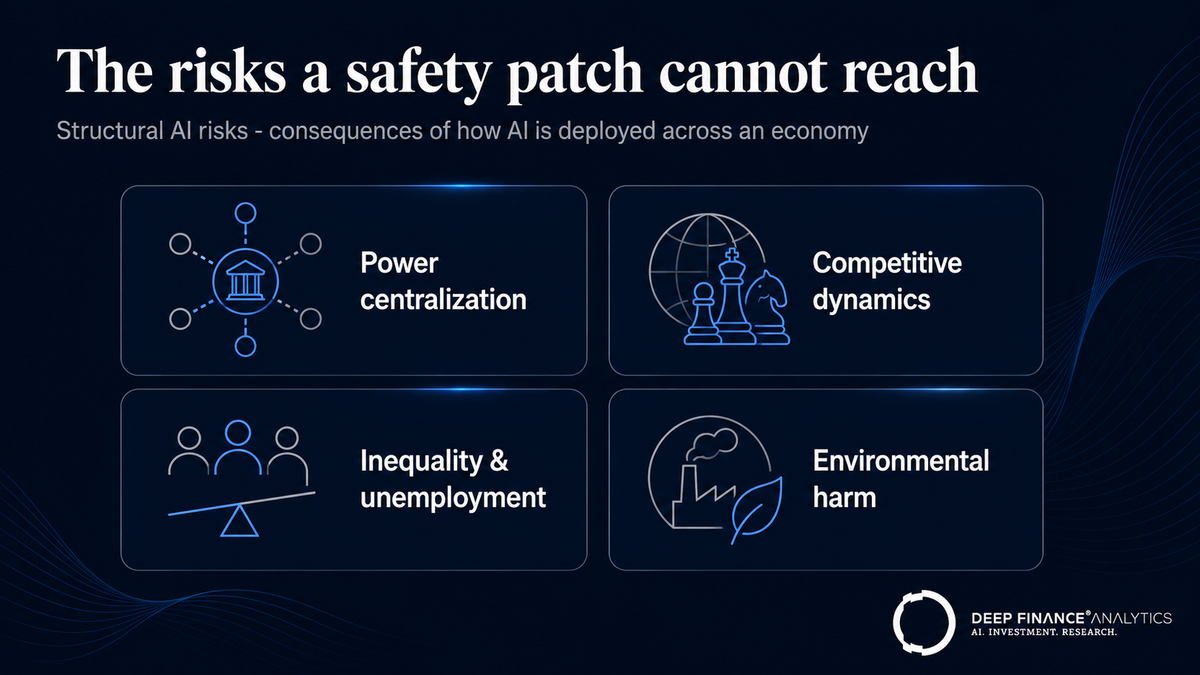
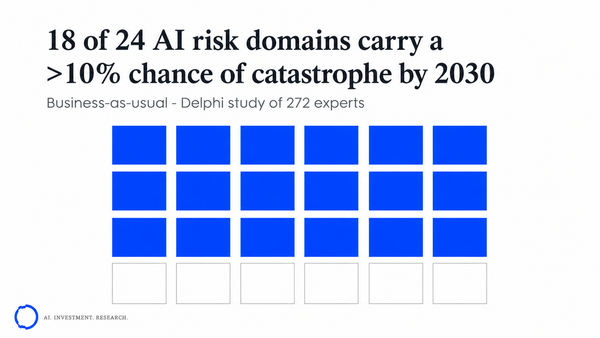
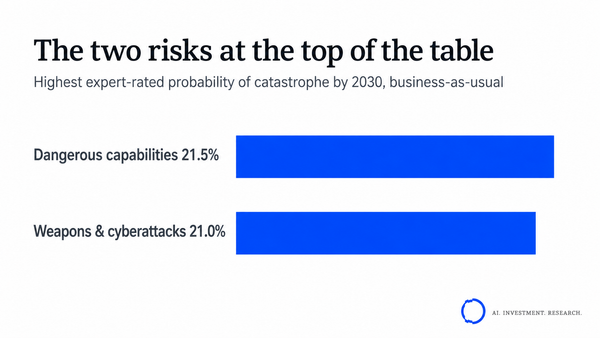
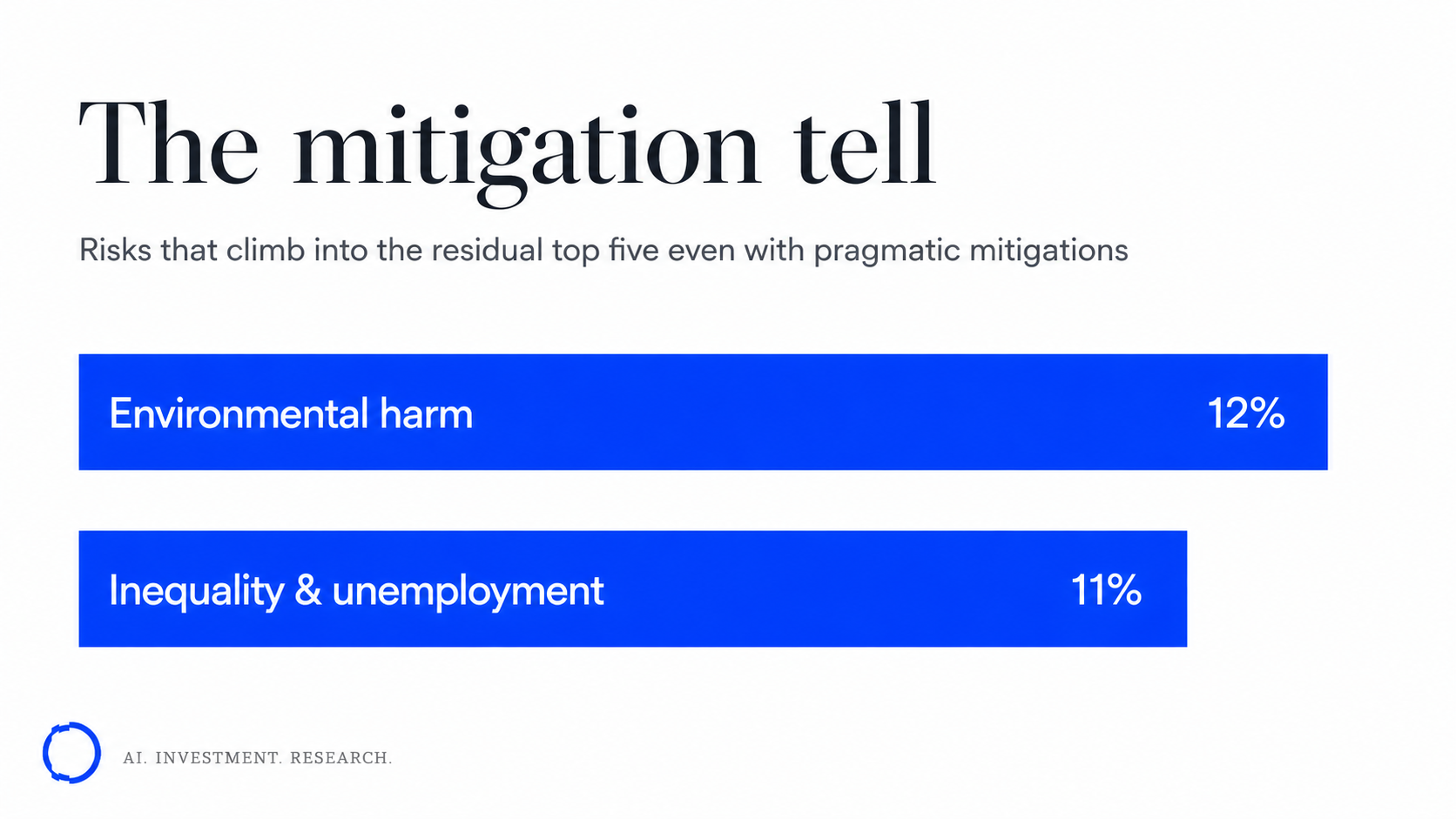
This is the second of four deep-dives behind our summary of the [272-expert AI risk Delphi study]. Where the first article looked at capabilities that a bad actor can point at a target, this one looks at the opposite kind of risk — harms that no single actor intends, that emerge from the shape of the system rather than from any one model's behaviour. Power centralization (18.0% business-as-usual probability of catastrophe by 2030) and competitive dynamics (16.6%) sit high on the severity table, and two more — environmental harm and inequality & unemployment — do something revealing under mitigation: they rise into the residual top five even after pragmatic controls are applied.
That is the tell. A risk that gets worse in relative terms once you apply the standard toolkit is a risk the standard toolkit was never built to touch. Figures attributed to the study are the experts' elicited probabilities; external market figures are cited and sourced; none of this is investment advice.
10-minute read · Updated July 16, 2026
Key takeaways
- Structural risks — power centralization, competitive dynamics, inequality, environmental harm — are consequences of how AI is deployed across an economy, not of any one model failing, so model-level safeguards barely move them.
- The tell is in the mitigation scenario: environmental harm (12%) and inequality & unemployment (11%) climb into the residual top five, because the tools most organisations reach for do not bite on them at all.
- The compute chokepoint is real and measurable: hyperscaler capital expenditure and data-centre energy demand are now on the scale of entire national economies, and both are highly concentrated in a handful of firms and locations.
- No vendor can "solve" structural risk, and we will not pretend otherwise. What a risk-intelligence platform can do is measure exposure to it — concentration coupling, regime shifts, and the second-order paths by which a systemic shock reaches a portfolio.
The risks a safety patch cannot reach
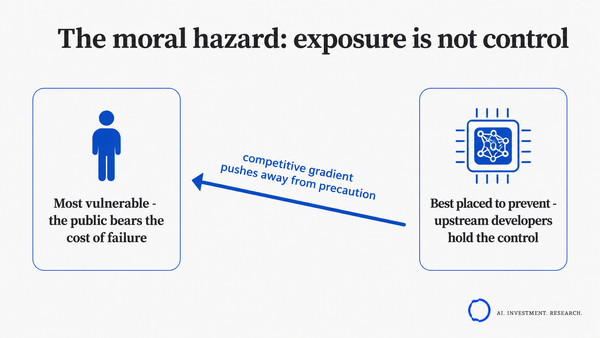
Most of the AI-safety conversation is implicitly about the model: align it, secure its weights, test its capabilities, document its behaviour. That framing works for the risks in our first deep-dive. It fails completely for this cluster, because the unit of failure is not the model — it is the market structure the model sits inside.
Consider the mitigation scenario from the study. Under pragmatic, cost-effective controls, every one of the 24 risks retains at least a 5% catastrophic probability, but the composition of the residual top five changes. Environmental harm rises to a 12% residual probability and inequality & unemployment to 11% — not because safety engineering makes them worse, but because it barely addresses them. You cannot align your way out of an emissions curve or a labour-market dislocation. These are policy problems wearing a technology costume.
Power centralization and the compute chokepoint
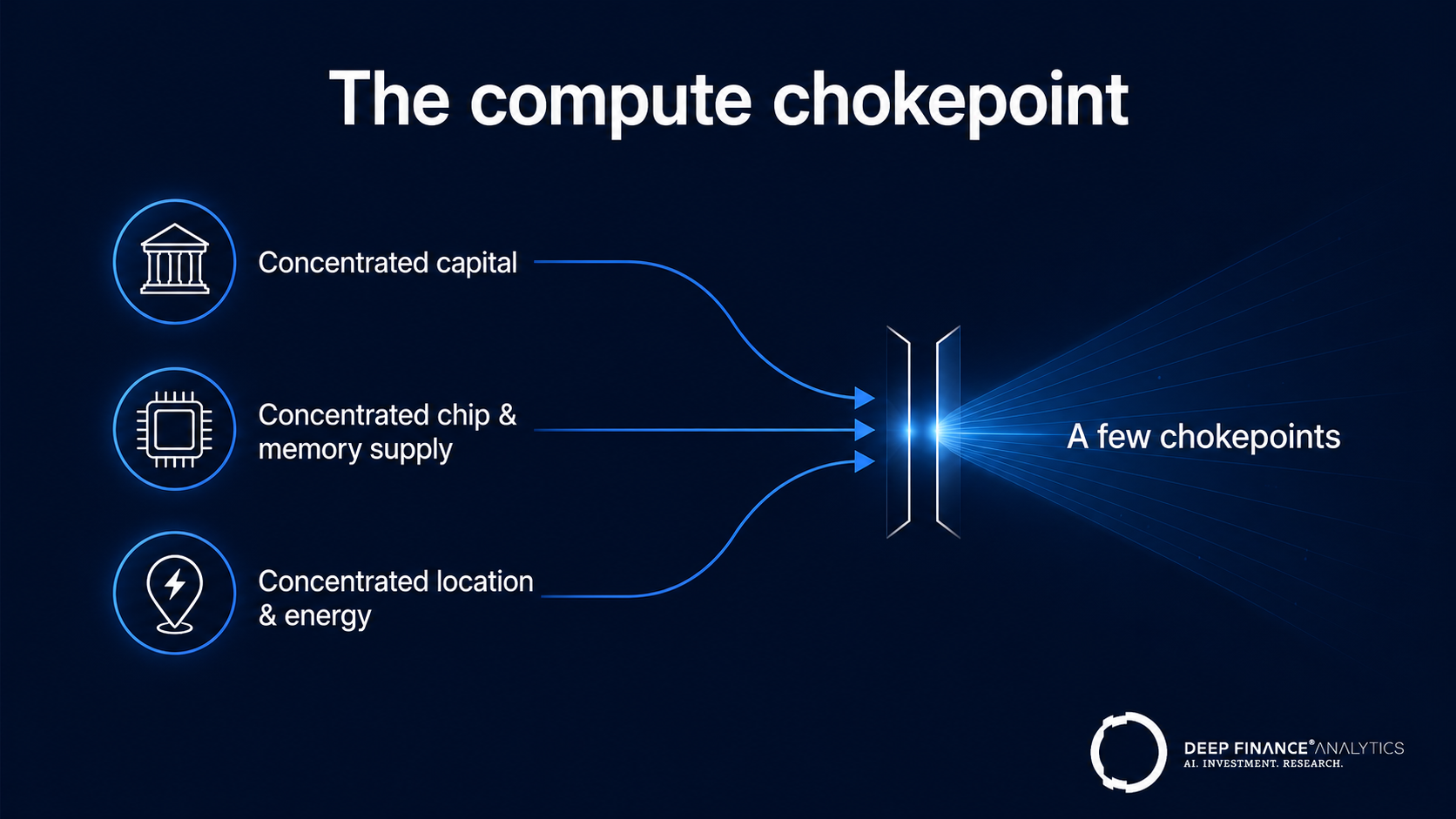
Of the structural risks, power centralization is the one with the clearest, most measurable mechanism, and it runs through compute. The economics are now on a scale that is hard to overstate. The capital expenditure of the largest hyperscalers exceeded $400 billion in 2025 and is set to rise by roughly three-quarters in 2026, with the five biggest committing on the order of $660–725 billion — an investment group larger than global annual investment in oil and gas production combined. The energy footprint follows: data-centre electricity consumption is approaching roughly 1,050 TWh, a level that would rank data centres among the largest electricity consumers on the planet, between major national grids.
Two features of that spend make it a centralization story rather than a mere growth story. It is concentrated in a handful of firms, and it is concentrated in a handful of places — one analysis projects a single US state's data-centre load reaching 41–59% of its electricity by 2030. Add a persistent shortage of high-bandwidth memory expected to run through at least 2027, and you have a supply chain with a small number of chokepoints. Concentrated inputs, concentrated capital, concentrated location: that is the anatomy of the risk the experts ranked third by severity.
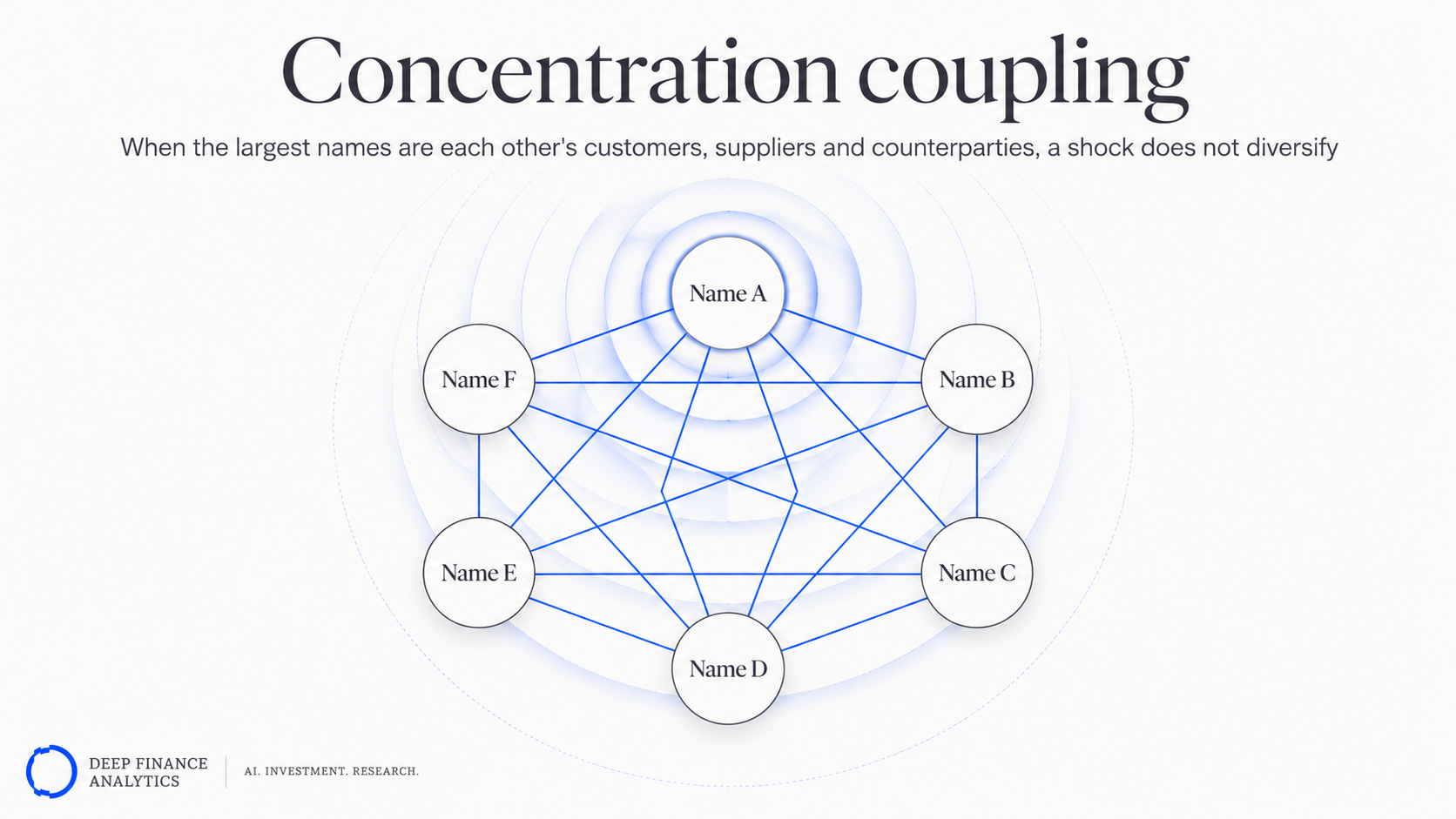
Operationalised: we have written about the portfolio version of this before. Our Aspects Q2 study documented concentration coupling — the largest handful of US technology names being simultaneously each other's customers, suppliers, and counterparties, so that a shock to the cluster is not diversifiable in the way a factor model assumes. Power centralization is that same coupling seen from the top down.
Competitive dynamics: the race that ships unsafe systems
If power centralization is about who ends up holding the resources, competitive dynamics is about what the race to get there does to safety. The study's fourth-ranked severity risk (16.6%) is the "race" behaviour in which states and firms prioritise strategic or economic advantage over caution and ship systems before they are safe. It is the structural engine behind several other risks at once — it is why dangerous capabilities get deployed quickly, and it is the reason voluntary restraint tends to lose, a point we develop in the governance article.
For an institution, the competitive-dynamics risk is not something you can hedge by picking better vendors. It is a property of the whole field, and it shows up as tempo — capabilities and deployments arriving faster than assurance can keep pace. The defensible response is not to predict the race but to shorten your own reaction time to its consequences.
The residual climbers: environment and inequality
The two risks that rise under mitigation deserve a moment on their own, because they are the ones institutions are most tempted to file under "someone else's problem." Environmental harm is, at bottom, the energy story above with a longer time horizon: the compute build-out has a physical footprint that model-level safety does not address. Inequality & unemployment is the labour-market counterpart — the distributional consequence of automating cognitive work at scale. Both are genuine tail risks in the study, and both require instruments — competition policy, labour protection, energy planning, international coordination — that sit entirely outside an AI-safety team's remit.
The honest institutional takeaway is not despair; it is scope. These risks will be governed, if they are governed, by policy. What a firm owes its board is a clear-eyed map of where its own exposure to those policy outcomes actually lies.
What a risk platform can — and cannot — do here
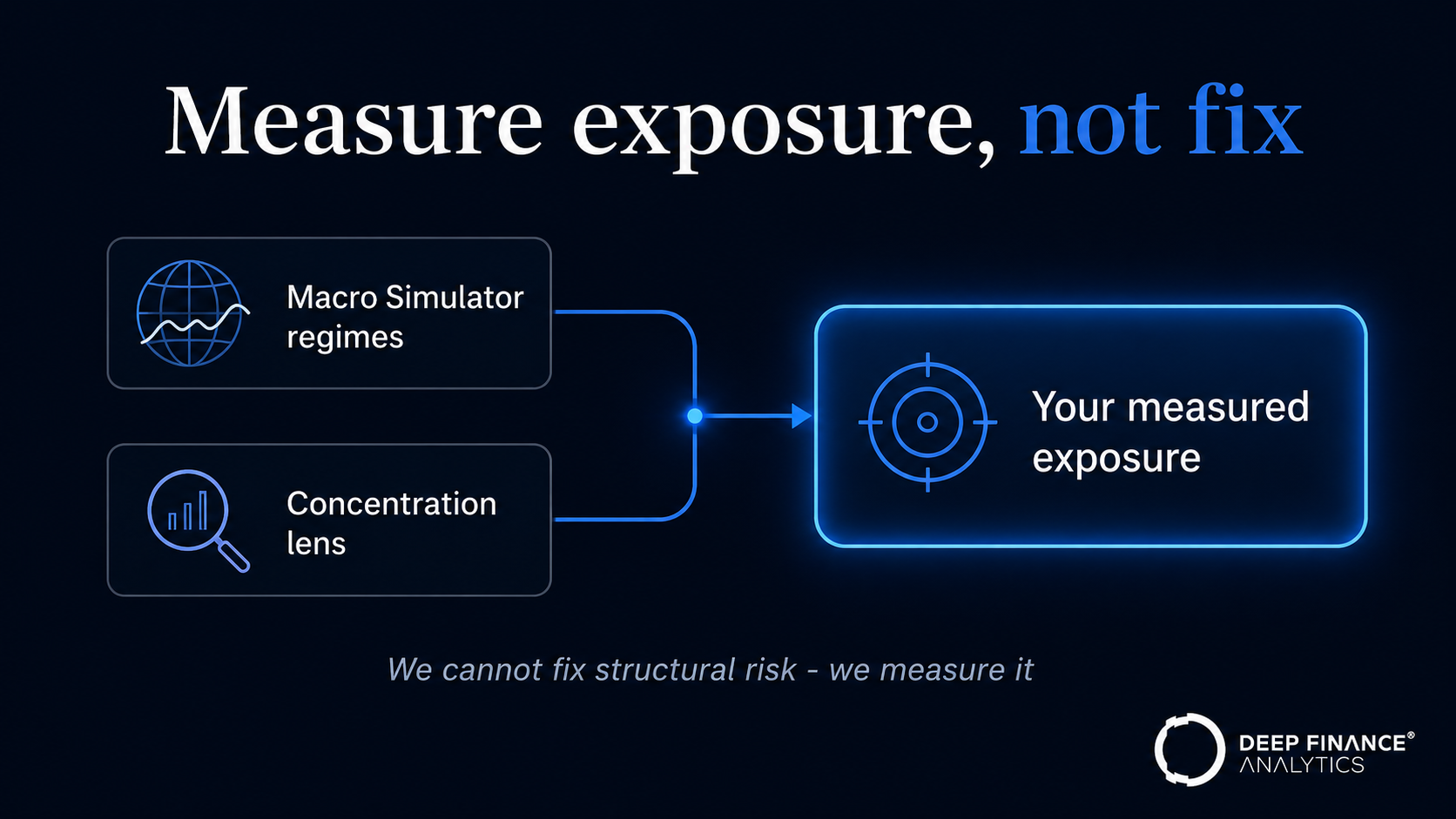
We will be plain about the limits, because pretending otherwise is how vendors lose credibility on exactly this topic. DF Analytics cannot reduce power centralization, cannot slow the race, and cannot fix an emissions curve. No model can. What our platform is built to do is measure exposure to these structural forces so that a firm is not surprised by them.
Two components do most of that work. The Macro Simulator maintains named macro regimes with monthly probability weights, so that a shift in the structural backdrop — a reflationary energy shock, a concentration-driven repricing — registers as a change in corroborated probability rather than as a surprise. And the concentration lens behind our Aspects work turns "the sector is coupled" from a worry into a measured quantity: which of your holdings sit inside the coupled cluster, which of your counterparties depend on the same chokepoints, and which second-order names would be dragged along by a shock to the first order. That is the difference between knowing structural risk exists and knowing your number.
Frequently asked questions
What is a "structural" AI risk?
It is a harm that emerges from the structure of the AI economy rather than from a single model malfunctioning — for example power centralization, competitive "race" dynamics, inequality and unemployment, or environmental harm. Because the unit of failure is the market or the economy, not the model, model-level safeguards do little to reduce these risks.
Why do environmental harm and inequality get relatively worse under mitigation?
In the study's pragmatic-mitigations scenario they climb into the residual top five — not because safety engineering worsens them, but because it barely touches them. They are consequences of how AI is deployed across an economy, and the standard model-level toolkit does not bite on them.
Can DF Analytics reduce structural AI risk?
No, and we do not claim to. These risks require competition policy, labour protection, energy planning, and international coordination. What our platform does is measure a firm's exposure — concentration coupling, regime shifts, and second-order propagation — so the risk is quantified and monitored rather than assumed away.
How does compute concentration connect to financial risk?
Concentrated capital, concentrated suppliers, and concentrated locations create a small number of chokepoints. When the largest technology names are also each other's customers and counterparties, a shock to that cluster propagates rather than diversifies — which is why we track concentration coupling as an explicit, measured exposure.
Related reading
- [Experts put a number on AI catastrophe: the 272-expert Delphi study]
- When capability outruns control: monitoring AI's most dangerous risks
- Aspects Q2 2026 — Tech & AI infrastructure
External references
- IEA — Energy demand from AI (Energy and AI)
- Brookings — Global energy demands within the AI regulatory landscape
- Belfer Center — AI, Data Centers, and the U.S. Electric Grid
About the author — Research — Deep Finance Analytics. Research produces the Insights analysis and the macro-regime and concentration work that sits behind the Risk Heartbeat and Aspects series. See the Insights hub for the full archive, or book a discovery call to discuss this post with the team.