Finance in the blast radius: the AI attack surface and how to watch it
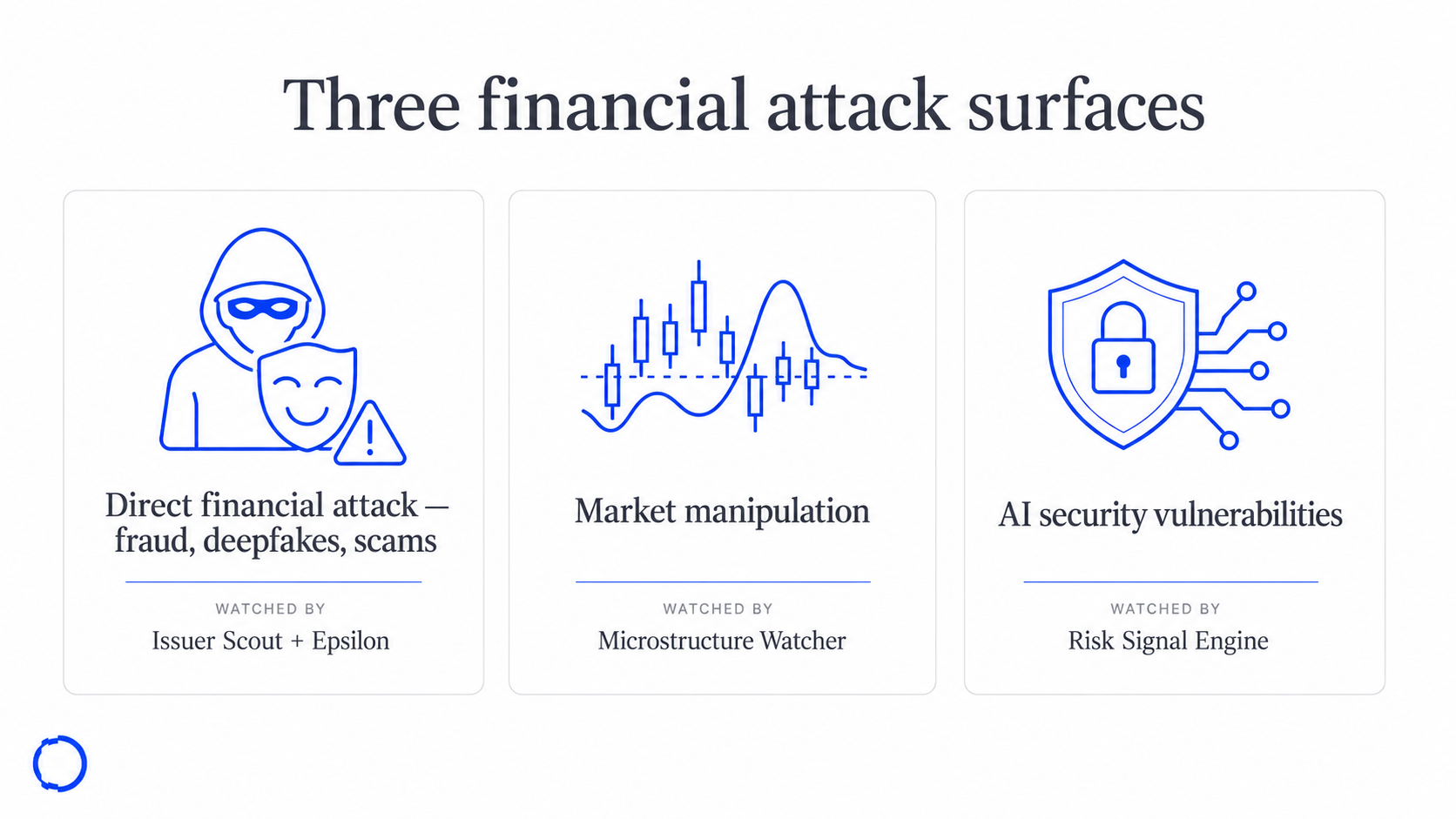
Experts rated finance among the most AI-vulnerable sectors: fraud, market manipulation, and AI security. The three financial attack surfaces, and the engines that monitor each.

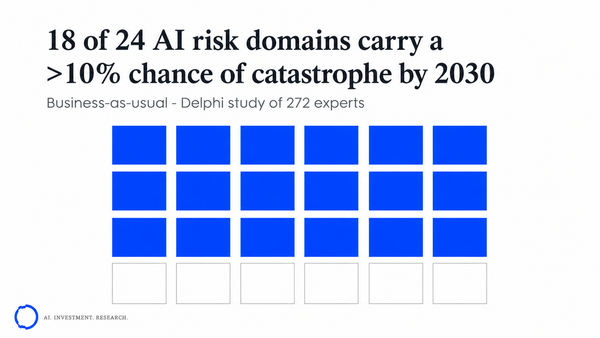
This is the fourth and final deep-dive behind our summary of the [272-expert AI risk Delphi study]. The first three worked at the level of the whole system — capabilities, structural harms, and the governance response. This one comes home to the desk. When the experts rated sectors by vulnerability, finance and insurance landed among the most exposed — behind only information and national security — flagged as highly vulnerable to direct financial attack (fraud, scams, market manipulation) and to AI security vulnerabilities. Health care sat alongside, vulnerable to privacy loss, discrimination, and unsafe over-reliance.
For our readers, that is where the study stops being a policy document and becomes a monitoring problem. This post breaks the financial exposure into three attack surfaces and maps each to the engine that watches it. External loss figures are cited; the study figures are the experts' judgements; none of this is investment advice.
10-minute read · Updated August 11, 2026
Key takeaways
- Experts rated finance and insurance among the most AI-vulnerable sectors — to fraud and scams, to market manipulation, and to AI security vulnerabilities — placing this study squarely on the risk desk.
- The numbers are no longer hypothetical: AI-enabled fraud has grown explosively, deepfake impersonation of trusted figures now drives the largest single category of deepfake losses, and individual incidents have cost firms tens of millions.
- The financial exposure splits cleanly into three attack surfaces — direct financial attack, market manipulation, and AI security — and each maps to a specific monitoring engine in our stack rather than to a single dashboard.
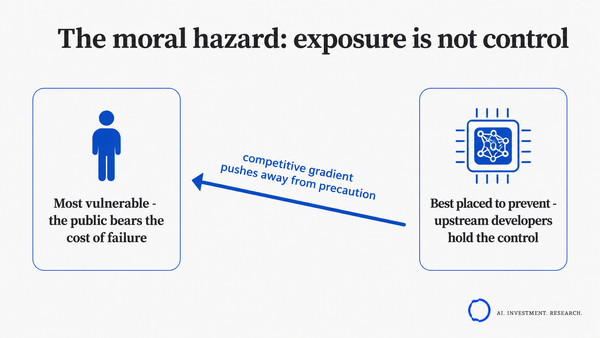
- The real point is compounding: a financial institution sits in the blast radius of several of these risks at once, plus its clients' exposures, which is the argument for treating AI risk as an enterprise concern, not a fraud-team line item.
The study's sector verdict
Vulnerability, in the study, was rated by actor and by sector, and the sector map is unusually blunt. Information and national security topped it — the domains most exposed to disinformation, privacy loss, cyberattack, and cascading geopolitical failure. Immediately behind them sat finance and insurance, rated highly vulnerable to direct financial attack and to AI security vulnerabilities. The distinction matters: finance is not merely a bystander to an information war, it is a primary target, because it is where the money is and where trust is directly monetisable.
What makes the finance rating actionable rather than alarming is that it decomposes. "Highly vulnerable" is not one thing; it is three fairly distinct attack surfaces, each with its own signal and its own countermeasure.
Attack surface one: direct financial attack
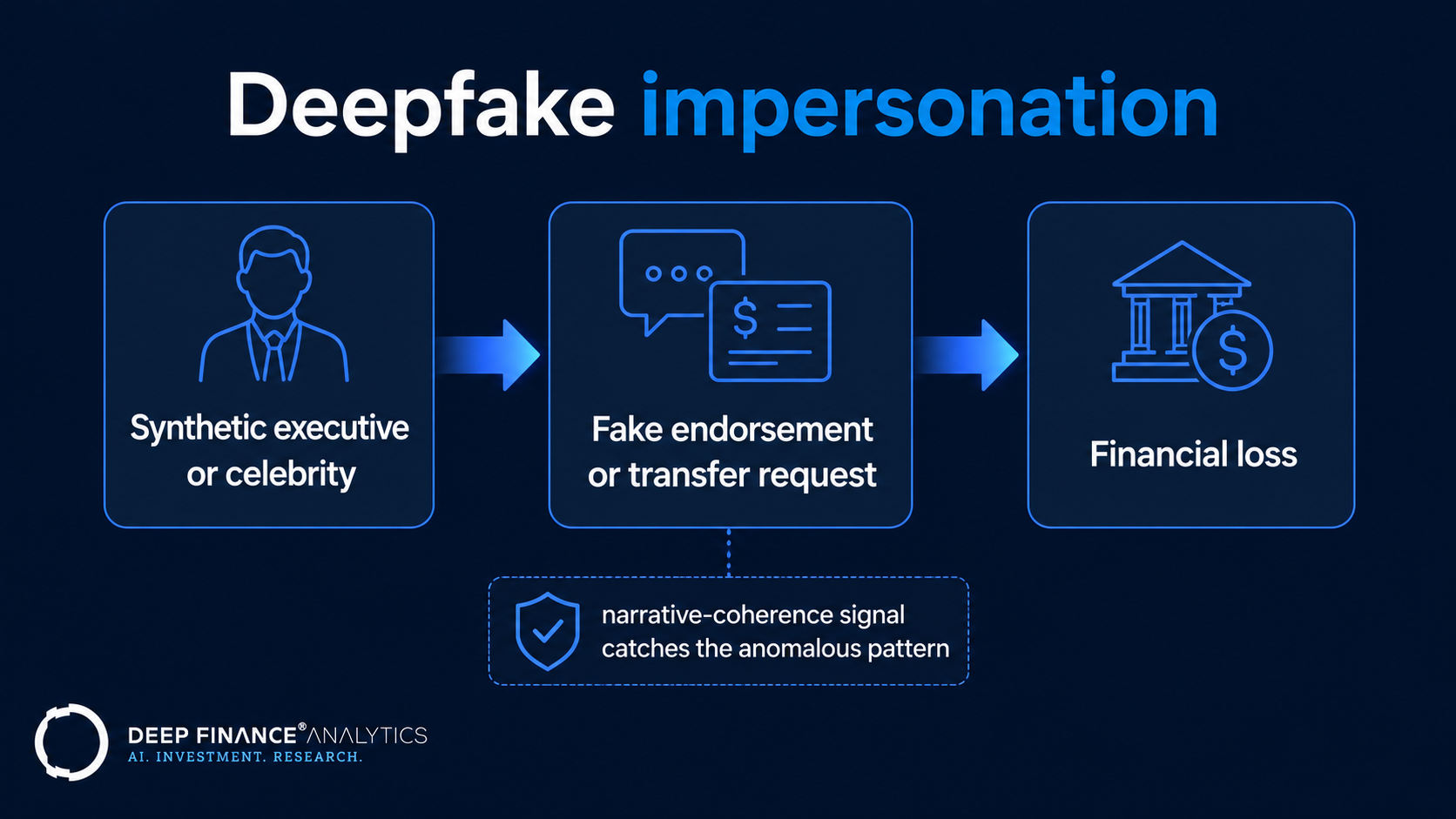
This is the surface with the loudest external evidence. AI has industrialised fraud. Reporting through 2025 and into 2026 describes AI-enabled fraud growing by more than a thousand percent year on year, with projected losses running into the tens of billions within a couple of years, and US consumers alone losing well over $12 billion to fraud in a single year. The fastest-growing vector is deepfake impersonation: synthetic video and voice of trusted figures — executives, celebrities, officials — used to endorse fake investments or authorise transfers. Impersonation of that kind is now the single largest category of deepfake fraud loss, and individual incidents have run to tens of millions of dollars from one convincing video call.
What the agent flagged: the signal that precedes many of these events is narrative, not numerical — a sudden coherence between an issuer's or executive's public profile and an unusual pattern of endorsements or communications. That is exactly the kind of thing Issuer Scout and the narrative-coherence layer behind Epsilon are built to catch: not the deepfake pixel-by-pixel, but the anomalous pattern of claims around a name, corroborated against microstructure and regulatory channels before it hardens into a loss.
Attack surface two: market manipulation
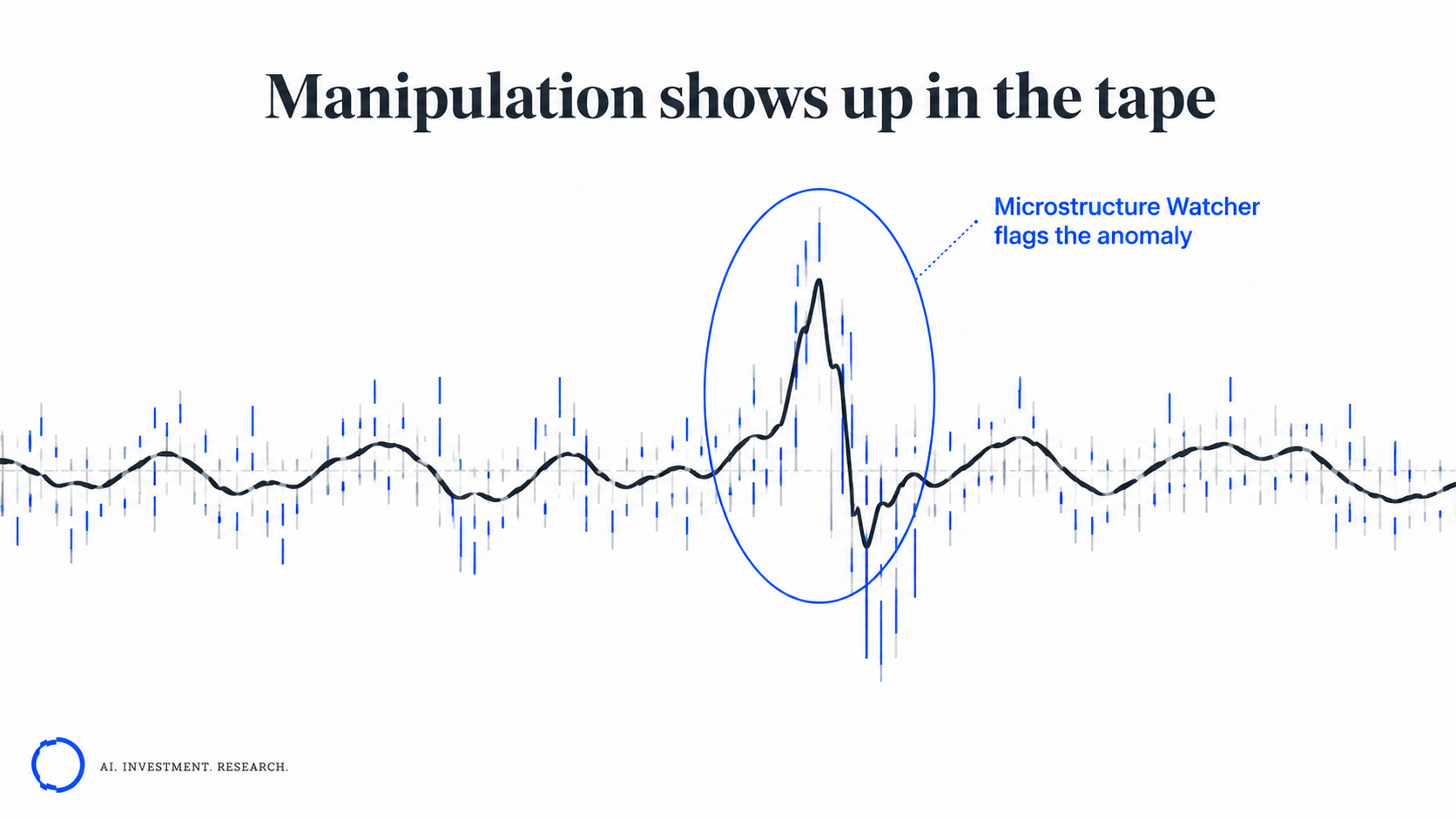
The second surface is subtler and, for an institution, arguably more dangerous. AI lowers the cost of coordinated, adaptive manipulation — synthetic sentiment, spoofed order flow, and rumour campaigns timed to move a price. The harm here does not announce itself as a fraud; it shows up first as behaviour in the tape.
This is the home turf of Microstructure Watcher, the agent that watches liquidity, order-book depth, trade-frequency anomalies, and unusual cross-market correlations. Manipulation that is invisible in the news feed is often visible in the microstructure well before it resolves, and — under the two-of-three coherence rule — a microstructure dislocation that coincides with an anomalous narrative signal and a supervisory flag is precisely the kind of corroborated event our stack promotes to flagged. A single odd print is noise; a coherent pattern across three independent channels is a warning.
Attack surface three: AI security vulnerabilities
The third surface is the one firms create themselves by adopting AI. Every model a firm deploys — for underwriting, screening, client service, or trading support — is a new component that can be attacked, poisoned, prompt-injected, or made to leak. The study's "AI security vulnerabilities" rating is a reminder that the tools meant to manage risk are themselves an attack surface.
Two parts of the platform address this directly. The Risk Signal Engine (bring-your-own-data) lets a firm fold its own security and fraud telemetry into the same coherence framework, so an internal anomaly is evaluated alongside external signal rather than in a silo. And PortIQ lets a firm stress the consequence rather than just detect the event — translating "what if this AI-security failure or this manipulation campaign hits these positions" into quantified factor shocks, P&L impact, and a ranked, pre-staged response, fully click-traceable.
Why the compounding is the real story
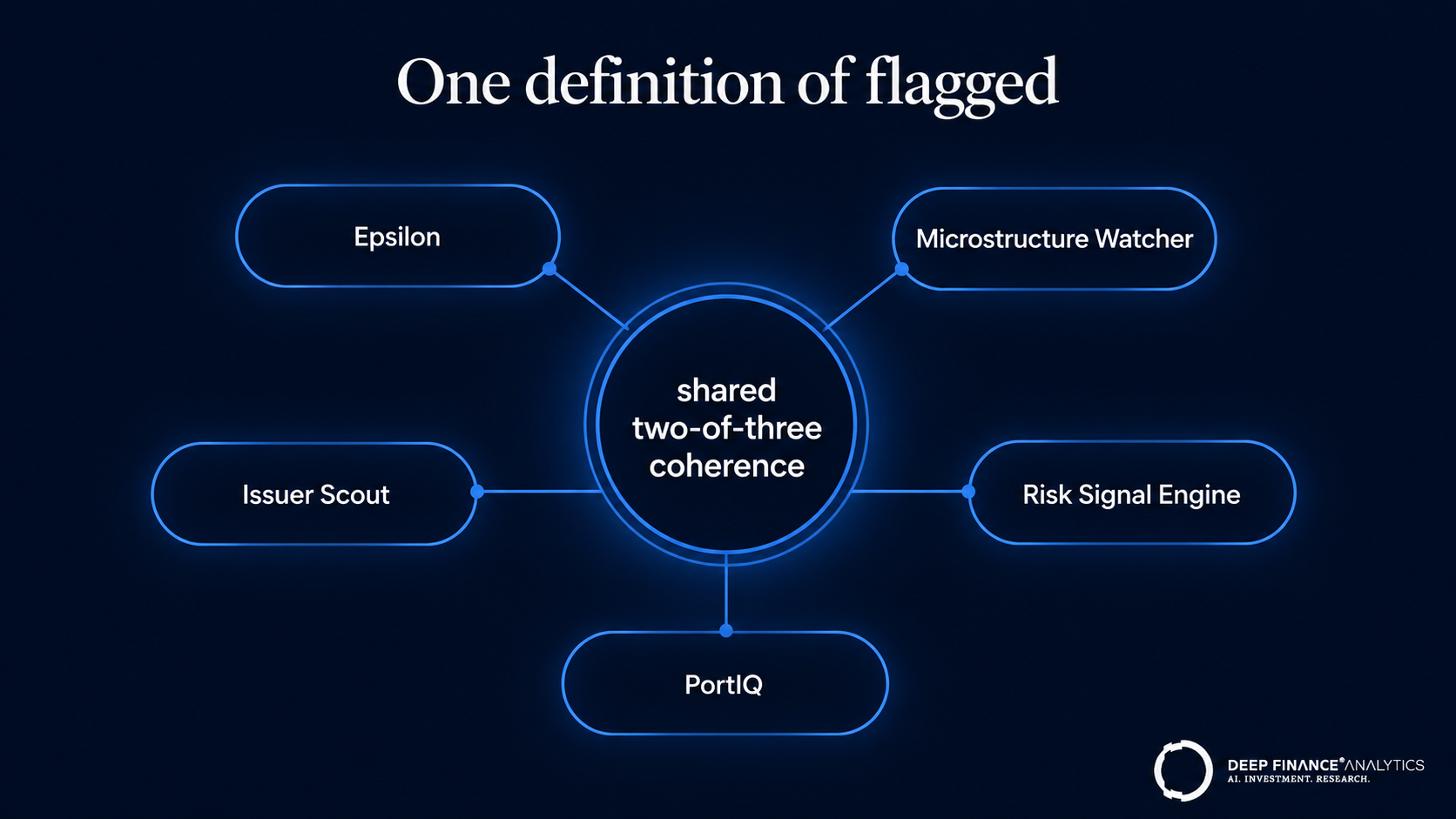
Read the three surfaces together and the study's deeper point emerges. Finance is not exposed to one AI risk; it is exposed to a financial-attack surface, an information-attack surface, and — through its clients across every other sector — a share of everyone else's failures. That compounding is why the correct owner of AI risk is the enterprise, not a single team, and why a coherent monitoring layer across fraud, microstructure, and security beats three disconnected point tools. Epsilon scores which single names are coherently elevated; Microstructure Watcher and Issuer Scout supply two of the three channels; the Risk Signal Engine brings your own data into the same frame; and PortIQ turns any of it into a costed scenario. The value is not any one engine — it is that they share a definition of "flagged."
None of this makes a financial institution immune; the study is explicit that these risks retain material probability even under mitigation. But it converts "finance is highly vulnerable" from a headline into a monitored, corroborated, and stress-tested exposure — which is exactly what a board should expect its risk function to be able to show.
Frequently asked questions
Why did experts rate finance so vulnerable to AI?
Because finance is a direct target, not a bystander. The study rated finance and insurance among the most vulnerable sectors — to fraud, scams, and market manipulation, and to AI security vulnerabilities — behind only information and national security. It is where money and monetisable trust concentrate.
What are the three financial AI attack surfaces?
Direct financial attack (fraud, deepfake scams, impersonation), market manipulation (synthetic sentiment, spoofed flow, timed rumour campaigns), and AI security vulnerabilities (attacks on the firm's own deployed models). Each has a distinct signal and a distinct countermeasure.
How does DF Analytics monitor these?
Issuer Scout and the narrative-coherence layer catch anomalous claim patterns behind impersonation and scams; Microstructure Watcher catches manipulation in the tape; the Risk Signal Engine folds in a firm's own security telemetry; and PortIQ stress-tests the consequence. All of them share the two-of-three coherence rule, so a concern is flagged only when independent channels corroborate it.
Isn't this just a fraud-team problem?
No — that is the study's point. A financial institution sits in the blast radius of several AI risks at once, plus its clients' exposures across other sectors. That compounding makes AI risk an enterprise, board-level concern rather than a single team's line item.
Related reading
- Experts put a number on AI catastrophe: the 272-expert Delphi study
- The moral hazard at the centre of AI risk — and the hard instruments that close it
- Epsilon: scoring idiosyncratic risk for IC review
External references
- Fortune / Experian — Consumers lost $12.5 billion to fraud, AI-powered scams set to explode in 2026
- Help Net Security — Financial groups lay out a plan to fight AI identity attacks
- Fourthline — Deepfakes in Financial Services: How AI Fraud Is Reshaping Risks in 2026
About the author — Product Marketing — Deep Finance Analytics. Product Marketing translates engineering and quant work into the narratives, factsheets, and walkthroughs used by clients. See the Insights hub for the full archive, or book a discovery call to discuss this post with the team.